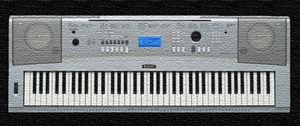
Yamaha DGX "portable grand" is the most playful yamaha keyboard for different melodies and world styles. Enjoy using it. |
|
|
full Yamaha
styles A admired arranger series from Yamaha, the Yamaha DGX grand piano keyboard series has keyboard instruments with more than 61 keys. The advanced models in this series come with 88 fully weighted piano action keys that feel more like a piano. These keyboards bring you the best of an arranger and a digital piano. Though the Clavinova and the Arius pianos look and feel more like proper pianos, most music enthusiasts will find them quite expensive. Whereas a Yamaha DGX keyboard is far more affordable as far as price is concerned. Yamaha DGX 230 and Yamaha DGX 640 are two keyboards in this series, one at the lower end and the other at the top of this series. A typical Yamaha DGX grand piano keyboard is designed to be more portable, but some can still give you a decent workout. Weighted keys and bundled stand can be some of the reasons for making the keyboard a bit heavy. Keyboard functions like several sounds, styles, and effects can be found on these DGX keyboards. You will also find features like USB to Device terminal, USB to Host terminal, pitch bend on some of these models. Overall, the DGX keyboards give you the best of a digital piano and an arranger at a price that you cannot resist. These are any day more inspiring to practice upon than any other 61 key arrangers. So if all this sounds interesting, check out the 88 key Yamaha DGX grand piano keyboard today. 2-4 6-8 Ballad Ballroom Bigband Classic Country Disco Easy listening Instruments Jazz Latin Learning Polka Pop R&B Rock Unsorted World Xmas |
|
|---|---|
| In this site you can download free yamaha styles from everywhere in the world. Unique collections of voices, midi, style files and registry information in the whole world. | |
When you select “Renaissance EQ” from your DAW’s menu, you aren't opening a standalone plugin file. You are opening a compartment inside the WaveShell that tells the DAW how to talk to that specific Waves processor. The audio industry is plagued by fragmentation. DAWs use different formats: VST (Steinberg), AU (Apple), AAX (Avid), and sometimes RTAS (legacy Pro Tools). Managing updates, bug fixes, and compatibility across 200+ plugins for five different formats is a developer’s nightmare.
If you have ever produced music, mixed a podcast, or mastered a track using professional audio software, you have almost certainly used a Waves plugin. But before you even load up that classic Renaissance Compressor or the iconic CLA-76, you’ve interacted with a piece of technology that remains invisible to most users: WaveShell . waveshell
Tucked away in your Digital Audio Workstation’s (DAW) plugin list under names like “WaveShell 1-AAX,” “WaveShell-VST3,” or “WaveShell-AU,” this unassuming entry is far more than just another plugin. It is the architectural backbone of the entire Waves ecosystem. In simple terms, WaveShell is a wrapping technology . It acts as a universal host inside your DAW. Instead of installing hundreds of individual plugins (each with its own unique coding language and potential for crashes), Waves installs one shell. That shell then holds all your individual plugins—from the Eddie Kramer guitars to the L2 Ultramaximizer—inside it. When you select “Renaissance EQ” from your DAW’s
The next time you load up a session and see that little orange Waves logo, take a second to appreciate the invisible container holding it all together. Do you have a different "WaveShell" in mind (e.g., a physics concept, a marine structure, or a different software)? Let me know for a revised article. DAWs use different formats: VST (Steinberg), AU (Apple),