
Visual Audio Splitter & Joiner
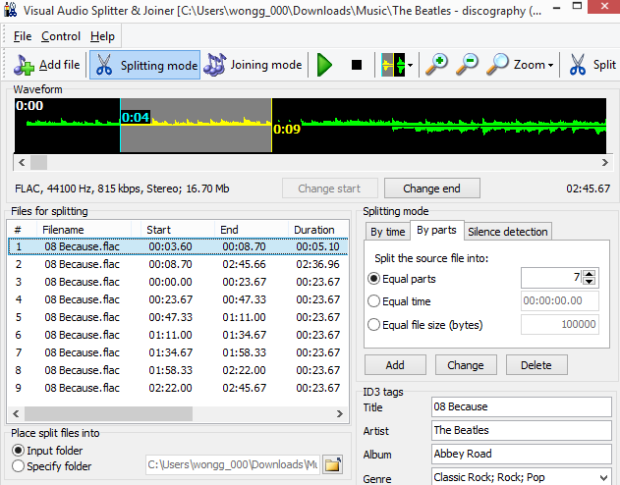
A handy software utility that can split and combine audio files. Cut files fast and easy using the waveform without losses in quality.


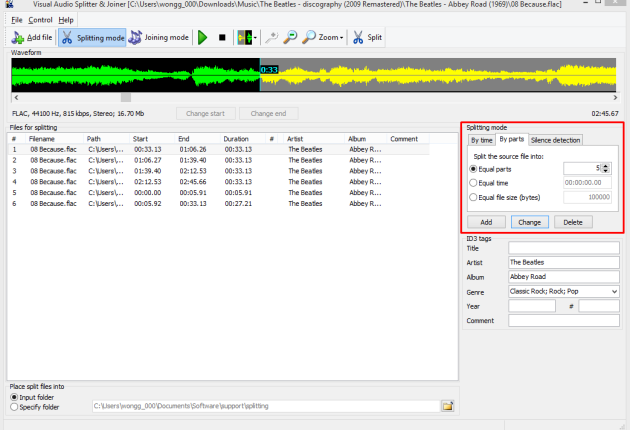
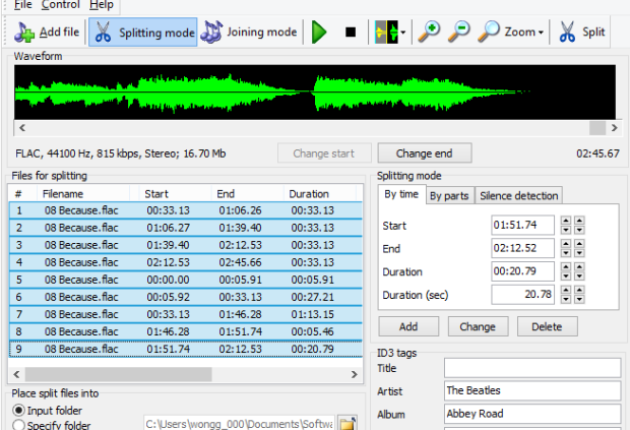
Split MP3, WMA, APE, and WAV files by a number of equal parts, by size, by duration. All the supported formats are split directly, without conversion!




Visual Audio Splitter & Joiner allows you not only to split multiple audio files at once but also in any order. Join MP3, APE, WMA, and WAV files in any succession. Note that only parts in the same format can be merged. So if you want to merge files in different formats, you can convert them to the desired output format with AudioConverter Studio.

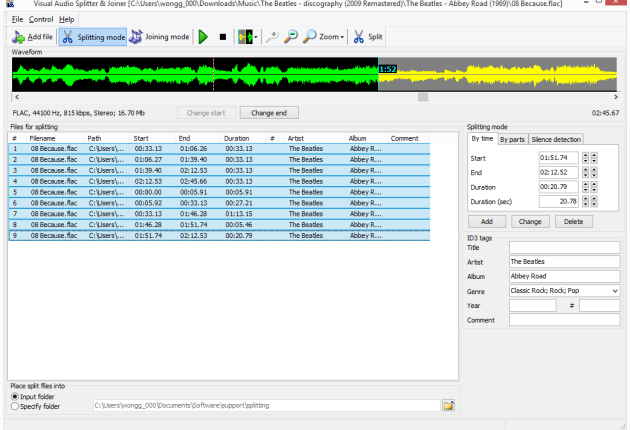
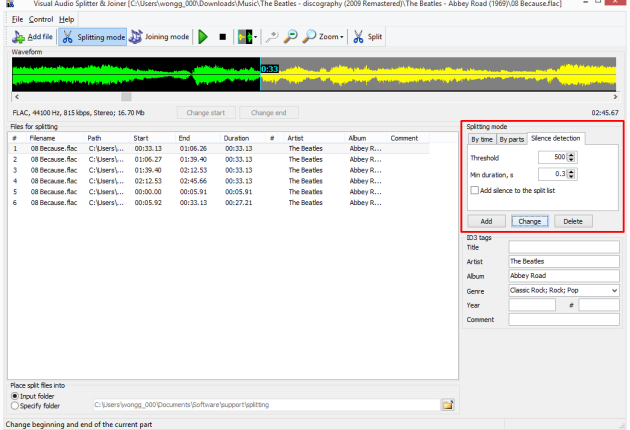
Suppose that you have an album of your favorite band in a single file and want to get easy access to each song. Visual Audio Splitter & Joiner is the right tool for this. In just a few seconds it will detect pauses between songs using the silence detection feature. All you need to do is to click the “Split” button. The MP3 splitter will deliver the result in virtually no time.

CUE files can be also used with media players. Nowadays many media players support CUE sheets either by using plugins or by initial design. CUE sheet is a simple text file (in ASCII encoding) which contains information concerning how audio tracks should be laid out on a CD.
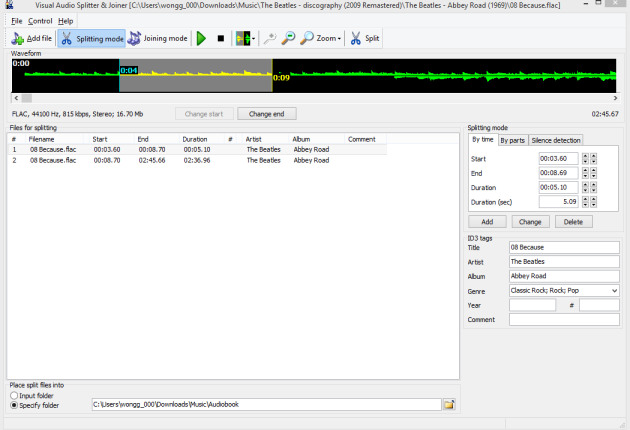
Visual Audio Splitter & Joiner will help you create CUE sheets that will retain the detailed information. In this case, you don’t actually split the file but merely save the information about its parts into a CUE file.


Visual Audio Splitter & Joiner is so fast that you might ask: “Is it good for my files?”. The funny thing is, however, that Visual Audio Splitter & Joiner has absolutely no impact on quality.

Here’s a short, useful story about observing a sister’s friend’s lifestyle and entertainment choices—and the quiet lessons hidden in them. The Lantern and the Screen
Claire later whispered, “Maya works 60-hour weeks in PR. This is her survival system.” That’s when it clicked. Maya’s lifestyle wasn’t about showing off. It was a deliberate counterbalance to burnout. Her entertainment wasn’t passive consumption—it was active restoration. my sisters hot friend
Maya’s living room had no TV. Instead, there was a projector aimed at a bare white wall, a shelf of vinyl records, and a Korean skincare fridge humming beside a matcha station. “Entertainment isn’t just what you watch,” she said, pulling out a tarot deck. “It’s what you do .” Over three hours, we didn’t just sit. We made DIY candles, listened to a true-crime podcast while painting thrift-store ceramics, and ended with a silent disco in her kitchen (she had four LED headphones). Every activity was designed to be shared , tactile , and photographed —but not obsessively. She posted one blurry group shot. “The rest is just for us,” she shrugged. Here’s a short, useful story about observing a
Watch what your sister’s friend avoids as much as what she does. Maya never scrolled TikTok before bed. She never said “I’m bored.” Her entertainment had intention: connection, creativity, or rest. If you’re feeling drained, ask yourself—are your leisure choices filling you up or just filling time? Maya’s lifestyle wasn’t about showing off
Other people’s lifestyles aren’t competitions—they’re menus. You don’t have to order everything. Just taste what feeds you.
My sister, Claire, has a friend named Maya. Maya is the kind of person who makes you feel underdressed for a grocery run—flawless skin, curated playlists, and a weekend schedule that looks like a festival lineup. Last summer, I tagged along with Claire to Maya’s apartment for a “low-key hangout.” That’s when I saw it: a lifestyle built entirely around entertainment as fuel.
A month later, I started my own low-key ritual: Friday nights, no screens, one new recipe, and a shared playlist. It didn’t look as polished as Maya’s, but it felt like borrowing a little of her lantern light.